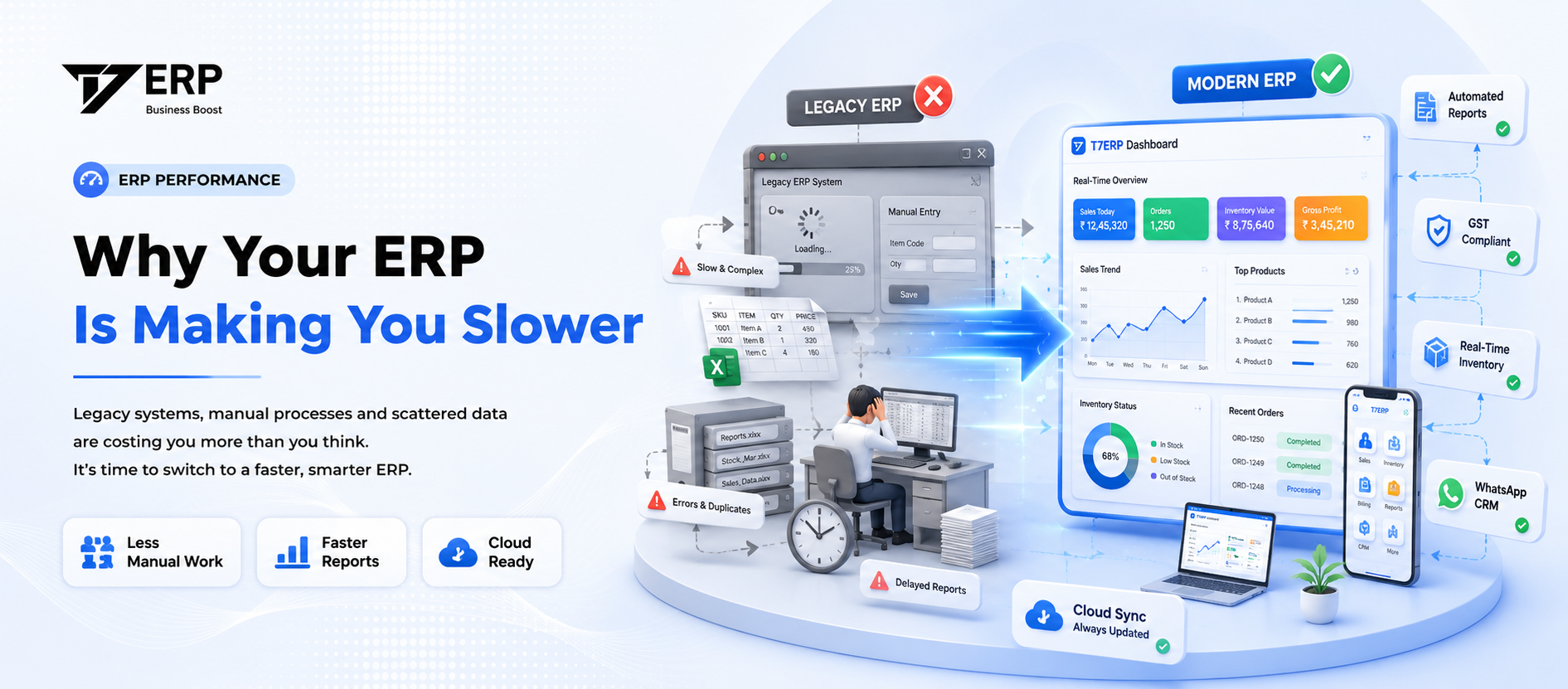
Key Takeaways
- The specific ways a legacy ERP slows your team down — and what it costs in real rupees.
- Why most traditional ERP systems were designed for large enterprises and quietly punish SMBs.
- What 'out-of-the-box' actually means when evaluating new ERP software.
- The 5 signs your current ERP is a liability, not an asset.
- How to switch systems without losing historical data or disrupting operations mid-year.
Rs 1.8 lakh
Average annual cost of manual data entry errors and rework for Indian SMBs
62%
Of Indian SMB owners say their ERP requires IT support for routine tasks
4–9 months
Average implementation time for a traditional ERP in an Indian mid-size business
You bought the ERP to save time. Two years later, your team spends three hours a day entering the same data into three different screens.
Legacy ERP slows Indian SMBs down more than they realise. Discover the 5 warning signs, the hidden cost of staying, and how to switch in 4 weeks without disruption.
01The hidden cost of manual data entry — it's not just time
Every business owner knows manual entry is inefficient. What most don’t calculate is what it actually costs.
Take a typical Indian distribution business: 80 purchase invoices entered manually. Typos on supplier GSTINs mean GSTR-1 and GSTR-2B mismatches, resulting in lost Input Tax Credit. Direct labour, error correction reworks, and compliance CA fees compound quietly.
Hidden Costs
The Hidden Costs of Manual Entry
Direct Labour
Hours spent typing purchase entries manually.
Rs 40,000–80,000/yr
Error Correction
Finding and fixing incorrect data entry typos.
Rs 15,000–40,000/yr
Compliance Mismatches
ITC mismatches and CA fees for filing reworks.
Rs 20,000–60,000/yr
02Why legacy ERP was built for someone else's business
The ERP systems that dominate the Indian market were designed for large enterprises with dedicated IT administrators. When SMBs buy them, they get redundant features and none of the local workflows like e-invoicing, GSTR, TDS, HSN codes, or WhatsApp payment reminders. The mismatch is structural.
03The 5 signs your ERP is a liability, not an asset
A good ERP should make your team faster. If they run parallel Excel spreadsheets, require IT help for basic reports, take over 3 days to onboard new users, take 2+ days for month-end close, or pay for unused modules — it is a liability.
Checklist
Liability Self-Assessment
Parallel Excel systems
Staff maintain separate spreadsheets because the ERP is not trusted.
IT support dependent reports
Generating standard reports requires raising database support tickets.
Slow onboarding time
New billing operators require more than 3 training days to function.
Slow month-end close
Accounts team takes more than 2 working days to reconcile GSTR entries.
Unused paid modules
Paying for modules that remain unactivated due to setup complexity.
04What "out-of-the-box" actually means — and what to look for
Out-of-the-box means raising a GST invoice on Day 1 without consulting dependencies. You configure products and balances once, and the system is ready without weeks of IT configuration.
05The real cost of switching (and why it's less than staying)
Fear of migration keeps SMBs on broken systems. But staying on a legacy ERP costs more in manual labor, CA fees, and compliance reworks.
Math Comparison
Cost of Switching vs Cost of Staying
Cost of Switching (One-time)
Total: Rs 33k–1L
Cost of Staying (Annual ongoing)
Total: Rs 80k–1.9L / year
06How modern ERP for Indian SMBs is built differently
Modern architectures default to GST-ready invoicing, automated GSTR file structuring, multi-GSTIN branches, and native WhatsApp CRM. This reduces the manual return prep from hours to minutes.
T7 ERP was built specifically around how Indian retail, distribution, and manufacturing businesses actually operate — with GST, WhatsApp CRM, multi-branch inventory, and accounting all in one platform.
07Your 4-week ERP evaluation and switch plan
Switching does not have to disrupt operations if done in stages. Shortlist, run parallel tests with real data, and set a clean monthly go-live target.
Switch Plan
4-Week Implementation Plan
Week 1: Diagnose & Shortlist
List top 5 pain points. Shortlist 2-3 GST-ready vendors and ask 3 qualifying questions.
Week 2: Demo & Test
Watch live demos of your workflow. Request trial account with your actual data.
Week 3: Parallel Test
Run transactions in both systems. Identify gaps and verify reconciliation reworks.
Week 4: Setup & Go-Live
Confirm data migration scope. Train team, set live date (ideally beginning of month).
Go-Live Tip: Target the first working day of a new month. Avoid launching during major festive seasons like Diwali.
Common mistakes Indian ERP buyers should stop making
How T7 ERP helps
T7 ERP is set up in just 2 to 3 working sessions. We import your product catalogues, set up branches, and configure GSTIN profiles so you raise invoices on Day 1. There are no expensive consultant dependencies, no custom modules to purchase, and no parallel spreadsheet rifts.
Want T7 ERP to handle this automatically?
Auto GSTR-1, GSTR-2B reconciliation, e-Invoice, and e-Way Bill in one platform built for Indian retailers.
Conclusion
Your ERP should be the fastest person on your team — not the slowest. The switch from a system that holds you back to one that moves with you is not a technology project — it is an operational decision with a clear return on investment.
Rahul Bhatia
ERP Consultant & Business Systems Advisor · T7 ERP
Rahul has spent 12 years helping Indian SMBs — retailers, distributors, and manufacturers — evaluate, implement, and get the most out of business software. He has led over 180 ERP migrations across Gujarat, Maharashtra, and Haryana, and writes about what actually determines whether a system adoption succeeds or quietly gets abandoned six months in.
Related Articles
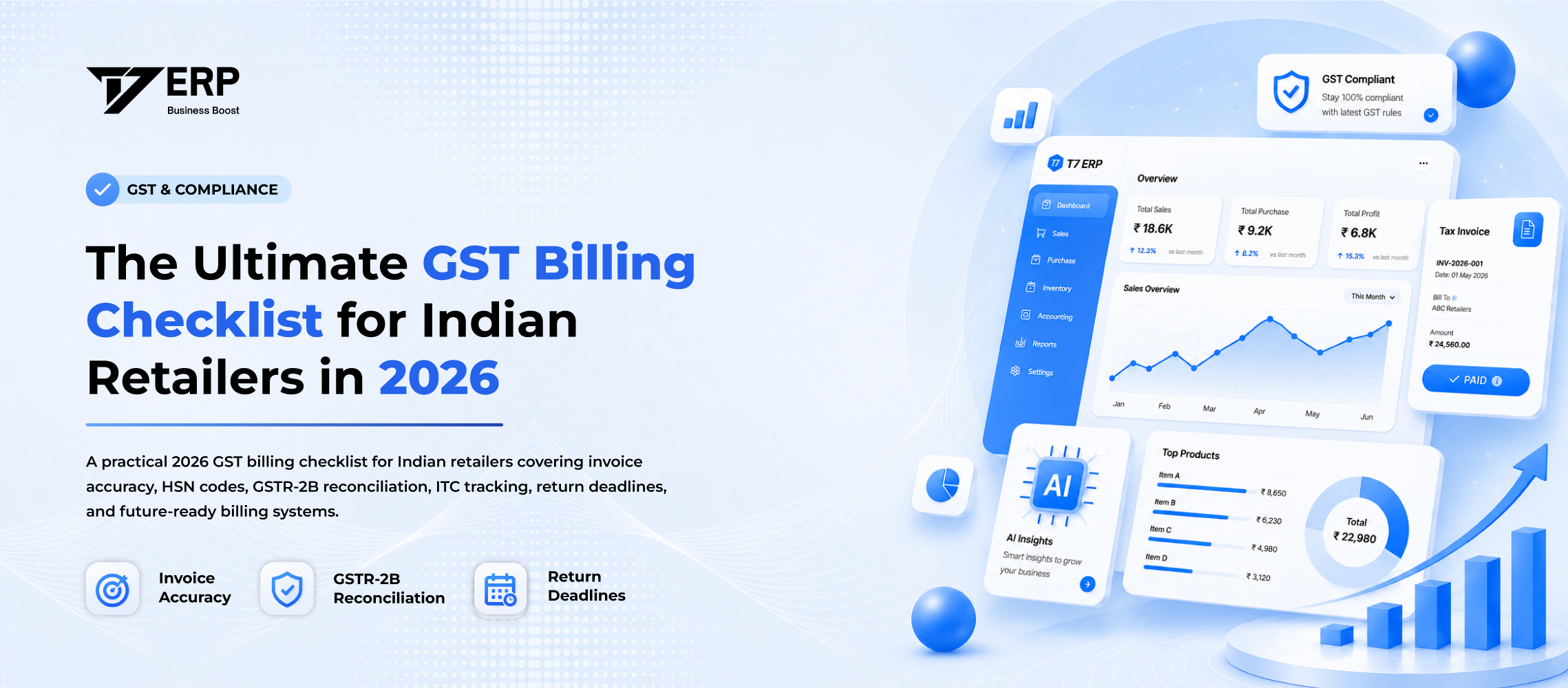
The Ultimate GST Billing Checklist for Indian Retailers in 2026
12 min read
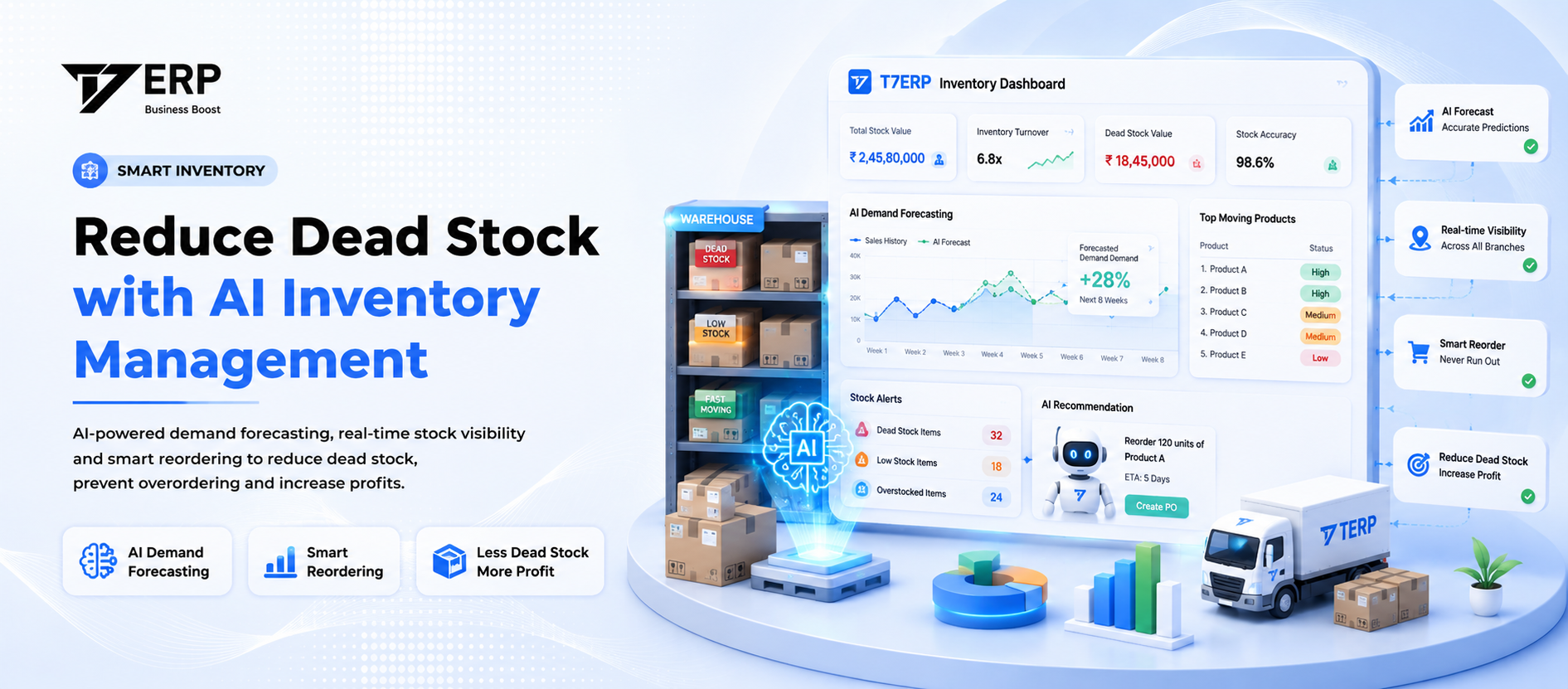
Reduce Dead Stock and Overordering with AI Inventory Management
7 min read

WhatsApp for Business: How Indian Retailers Are Using It to Sell More
7 min read
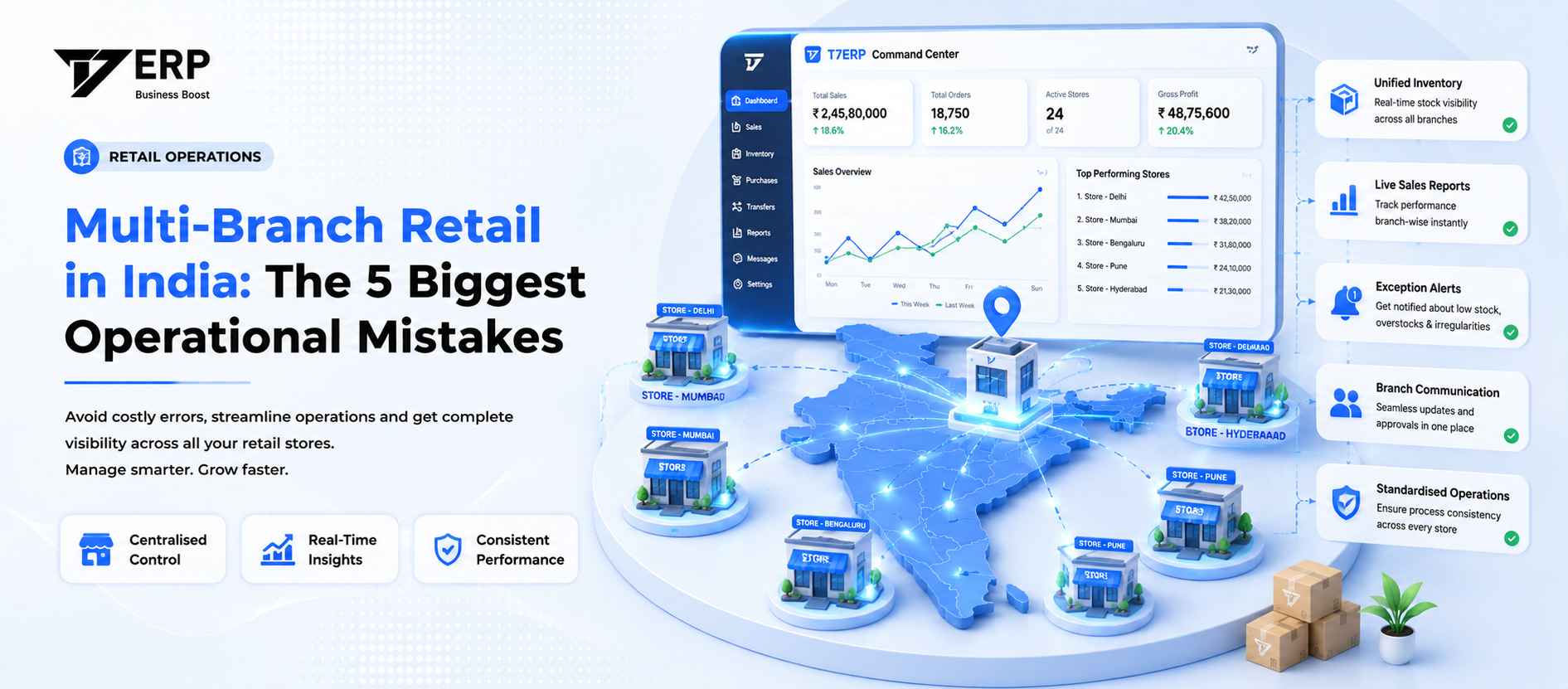
Multi-Branch Retail in India: The 5 Biggest Operational Mistakes
7 min read