Key Takeaways
- Verify GSTIN and registration details every quarter.
- Include all mandatory fields on every B2B invoice.
- Reconcile purchase register with GSTR-2B every week, not monthly.
- Track blocked credits under Section 17(5) separately from eligible ITC.
- File GSTR-1 and GSTR-3B on time without last-minute cleanup.
Rs 18K
average monthly ITC left unclaimed per store
8
compliance areas every retailer must cover
72%
of GST notices are from reconciliation mismatches
If you run a retail business in India, GST is not just a month-end tax formality. It touches every sale, purchase, supplier invoice, return, and credit claim. One incorrect GSTIN, missing invoice field, wrong HSN code, or delayed supplier filing can create avoidable cash flow and compliance trouble.
This checklist is built for busy retailers who want a practical reference for 2026, whether you manage one store or a growing chain.
The GST billing checklist: 8 areas retailers must cover
01Keep GST registration details updated
Start by checking that your GST profile reflects your current business. Outdated details can lead to return filing errors, invoice rejections, and missed notices.
02Include every mandatory GST invoice field
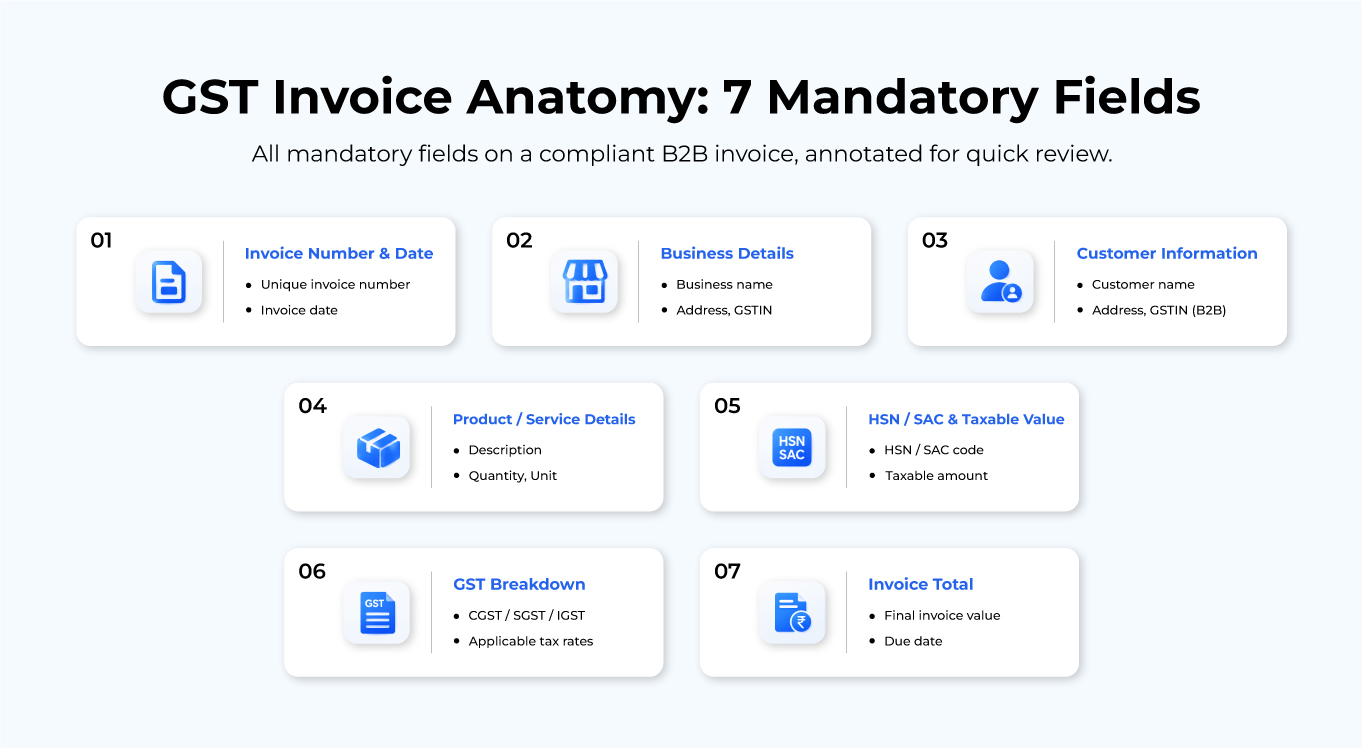
A GST invoice is both a legal document and the base record for ITC claims. Every B2B invoice should include the details below.
Infographic Zone
GST Invoice Anatomy
All mandatory fields on a compliant B2B invoice, annotated for quick review.
03Get HSN and SAC codes right
A wrong code can lead to the wrong tax rate, incorrect returns, customer ITC issues, and compliance scrutiny.
04Reconcile purchase register with GSTR-2B every week
GSTR-2B is the auto-generated ITC statement based on supplier filings. If a supplier has not filed correctly, their invoice may not appear in your GSTR-2B.
Infographic Zone
Weekly GSTR-2B Reconciliation Flow
Download GSTR-2B, match purchases, flag missing invoices, follow up with suppliers, then claim supported ITC.
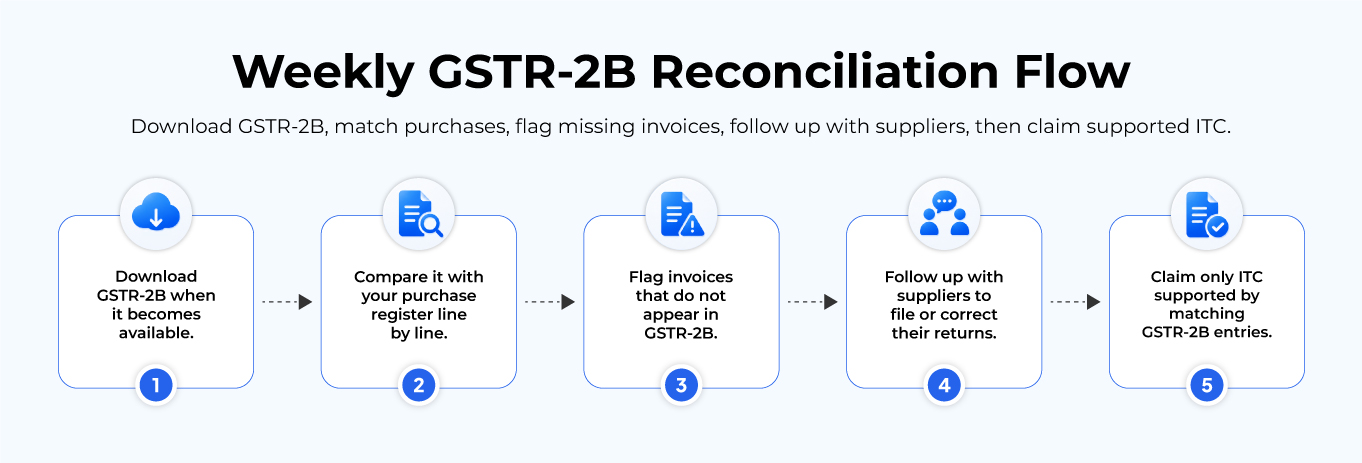
- 1Download GSTR-2B when it becomes available.
- 2Compare it with your purchase register line by line.
- 3Flag invoices that do not appear in GSTR-2B.
- 4Follow up with suppliers to file or correct their returns.
- 5Claim only ITC supported by matching GSTR-2B entries.
Want T7 ERP to handle this automatically?
Auto GSTR-1, GSTR-2B reconciliation, e-Invoice, and e-Way Bill in one platform built for Indian retailers.
05Track Input Tax Credit carefully
ITC is valuable, but it has conditions. Maintain a monthly tracker that separates eligible, blocked, reversed, and unclaimed credits.
06File GST returns on time
Late filing is one of the easiest GST costs to avoid. Build a shared compliance calendar and set reminders before every due date.
| Return | Purpose | Due date | Late fee |
|---|---|---|---|
| GSTR-1 | Outward supplies | 11th of next month | Rs 50/day; nil return Rs 20/day |
| GSTR-3B | Summary return and tax payment | 20th of next month | Rs 50/day plus 18% interest |
| GSTR-9 | Annual return | 31 Dec of next financial year | Rs 200/day up to 0.25% of turnover |
07Move from manual billing to a GST-enabled system
Manual billing often leads to duplicate invoice numbers, incorrect tax calculations, and last-minute reconciliation pressure.
08Stay ahead of GST rule changes
GST rules, rates, and ITC requirements can change through official notifications. Review changes quarterly with your accountant or tax advisor.
Common GST mistakes retailers should stop making
A practical monthly GST compliance rhythm
Infographic Zone
The 4-week GST compliance rhythm
A simple monthly operating calendar for keeping GST work out of the last-minute pile.
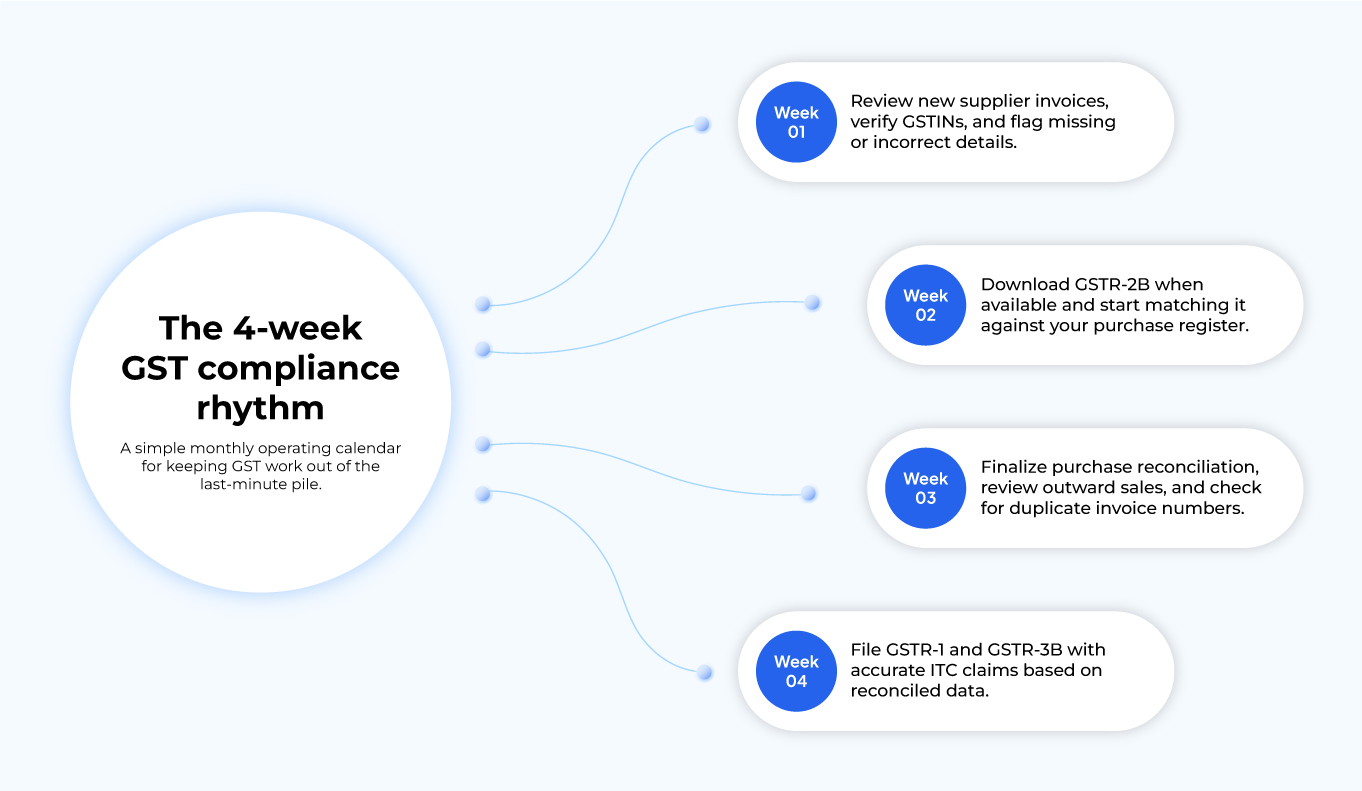
Week 1
Review new supplier invoices, verify GSTINs, and flag missing or incorrect details.
Week 2
Download GSTR-2B when available and start matching it against your purchase register.
Week 3
Finalize purchase reconciliation, review outward sales, and check for duplicate invoice numbers.
Week 4
File GSTR-1 and GSTR-3B with accurate ITC claims based on reconciled data.
How T7 ERP helps retailers stay GST-ready
T7 ERP helps Indian retailers manage GST billing, POS, inventory, accounting, purchase records, and reconciliation workflows in one connected system. It reduces manual billing errors, keeps invoice data structured, and gives teams cleaner records before return filing.
Want T7 ERP to handle this automatically?
Auto GSTR-1, GSTR-2B reconciliation, e-Invoice, and e-Way Bill in one platform built for Indian retailers.
Official sources to verify GST updates
Conclusion
GST compliance in 2026 is about more than avoiding penalties. It is about running a financially efficient business that is trusted by suppliers and ready to scale. Start with the area where your current process has the biggest gap, fix it this week, and move to the next one.
Rahul Kulkarni
GST & Compliance Expert · T7 ERP
Rahul has 9 years of experience helping Indian SMBs navigate GST compliance, e-Invoice workflows, and ERP implementation. He has worked with 200+ retailers and writes practical guides for business owners who want to stay compliant without needing a CA for every question.
Related Articles
Why Your ERP Is Making You Slower (And What to Do About It)
7 min read
Reduce Dead Stock and Overordering with AI Inventory Management
7 min read

WhatsApp for Business: How Indian Retailers Are Using It to Sell More
7 min read
Multi-Branch Retail in India: The 5 Biggest Operational Mistakes
7 min read