Key Takeaways
- The five operational mistakes that slow multi-branch growth.
- Why inventory visibility matters more than stock quantity.
- How centralised reporting improves decision-making.
- Best practices for branch-level accountability.
- The systems and processes required to scale profitably.
60%+
Retail operators report inventory visibility as a major challenge
3–5 Branches
The stage where manual management usually starts breaking down
20%+
Potential stock inefficiency caused by poor branch coordination
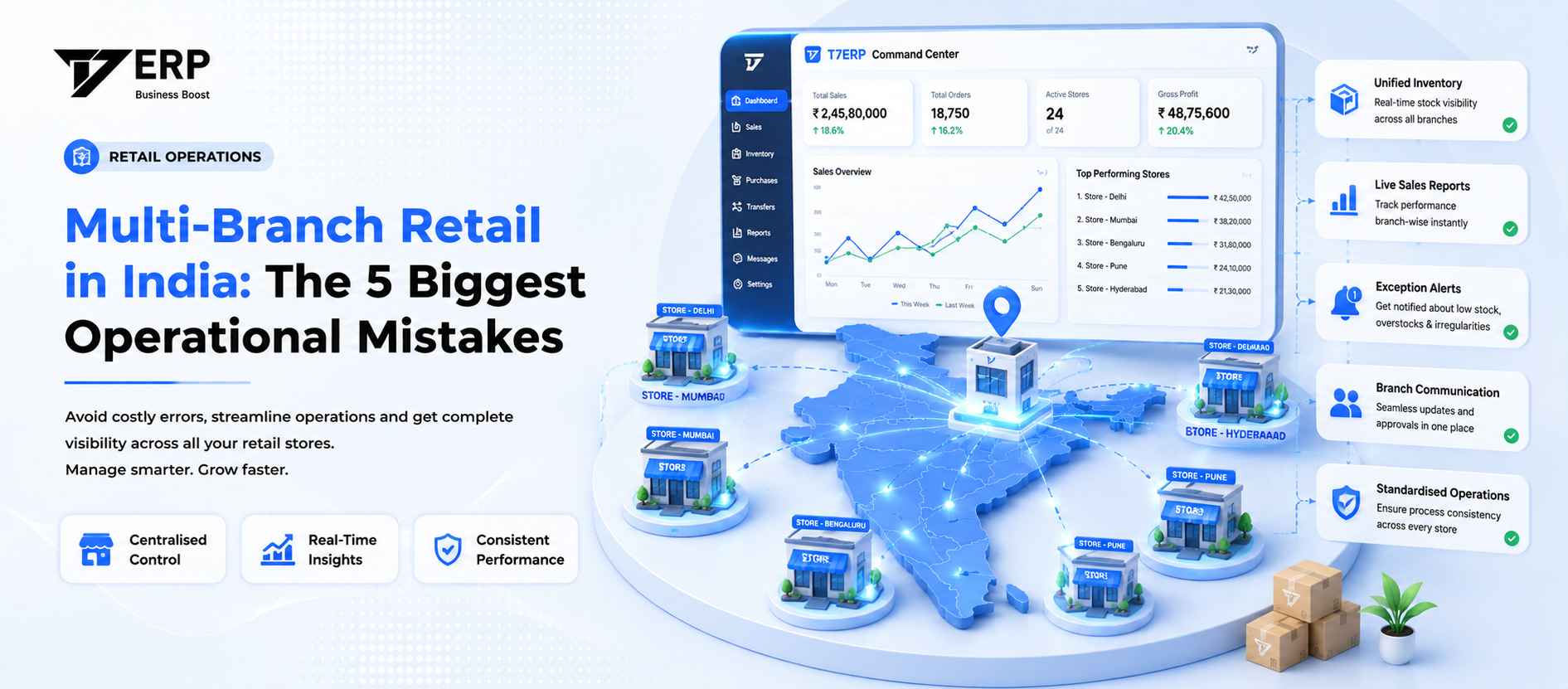
Opening a second store increases revenue. Opening a fifth store often exposes operational problems you never knew existed.
Expanding to multiple retail locations is exciting until inventory mismatches, reporting delays, and inconsistent operations begin affecting profitability. Here’s how Indian retailers can avoid the five biggest multi-branch management mistakes.
01Growth becomes harder when every branch operates differently
The first store is easy to control. You are physically present. You know the inventory, the staff, and the customers.
The challenge begins when additional branches are opened. Suddenly every location develops its own way of working — different pricing, different stock handling, different discount policies. Inconsistency replaces standardisation.
Operational Model
Standardised vs Fragmented Operations
- ✓Consistent pricing across all branches
- ✓Unified real-time stock levels visibility
- ✓Automated consolidated sales reporting
- ✓Strict approval thresholds for discount overrides
- ✓Consistent, repeatable customer service patterns
- ✗Price variations on the same SKU by branch
- ✗Stock discrepancies and excess inventory loops
- ✗Manual, delayed spreadsheet reports consolidation
- ✗Margin leakage from uncontrolled discounts
- ✗Inconsistent customer retail experiences
02Mistake #1: No real-time inventory visibility
Inventory is usually the first major problem multi-branch retailers encounter. One branch has excess stock, another has shortages, and management discovers the issue only after sales are lost.
Without real-time network-wide inventory visibility, working capital gets locked up unnecessarily, emergency purchases increase, and transfers are purely reactive.
Inventory Map
Centralised Inventory Visibility
Consolidated Stocks
View network-wide availability instantly in real-time.
Branch-wise Counts
Tracks warehouse vs branch-level counts accurately.
Inter-branch Transfers
Automate delivery challans and transit stock updates.
Aging & Low-Stock Alerts
Flag slow-moving items at location A to transfer to B.
Many growing retailers implement platforms such as T7ERP to maintain a single inventory view across all locations.
03Mistake #2: Managing branches using spreadsheets
Spreadsheets work well until they don’t. Most retailers start multi-branch operations using spreadsheets for sales, stock, and collections. The problem is delayed information and human errors. By the time consolidated data reaches management, decisions are delayed and opportunities missed.
Delay Flow
Spreadsheet Reporting Delays
Branch Sales Closed
End of Day
Manual Excel Export
Next Morning (+12 Hours)
Email to Accounts
Afternoon (+18 Hours)
Spreadsheet Consolidation
End of Week (+5 Days)
Management Decisions
Outdated Data (Lag: 7+ Days)
04Mistake #3: Measuring sales but ignoring profitability
Many retailers know how much each branch sells. Far fewer know which branch actually earns money. One branch may generate high sales but carry high discount margins, high staffing costs, and dead stock.
Profit Analysis
Revenue-focused vs Profit-focused Performance
Branch A (Revenue Focus)
Branch B (Profit Focus)
Systems such as T7ERP help retailers view branch-wise profitability and operational metrics from a central dashboard.
05Mistake #4: Weak staff accountability across branches
As store networks grow, the owner’s attention decreases, creating accountability gaps. This results in billing irregularities, unapproved discounts, and cash variances. You need role-based permissions and approval workflows.
Framework
5-Layer Accountability Framework
Role-Based Permissions
Billing staff raise invoices; only managers authorize discount overrides or stock write-offs.
Approval Workflows
System triggers notifications to headquarters for purchases exceeding set thresholds.
Branch Activity Logs
Audit trails record every transaction deletion, refund, or ledger modification.
Managers KPIs Reporting
Assess performance based on branch net margins, stock turn, and cash variances.
Real-time Alerts
Automate system exceptions flags (e.g. duplicate customer creations) for audits.
06Mistake #5: Expanding before operational processes are ready
Expansion amplifies existing weaknesses. If inventory and billing are weak today, they become chaos with five or ten branches. Standardise your operations first.
Complexity Curve
Complexity Scaling Warning
1 Store
Simple Control
Personal presence of owner manages stock and staff easily.
2–3 Stores
Coordination Gaps
Stock transfer lag occurs. Pricing discrepancies emerge across locations.
5+ Stores
System Breakdown
Spreadsheets consolidate too slow. Severe dead stock and leakage risks.
07The retailers that scale best focus on visibility, not control
Successful multi-branch operators create systems that make performance visible, enabling faster decisions, better inventory transfers, and standard collections.
08Practical multi-branch operating rhythm
Below is the practical daily, weekly, monthly, and quarterly operating schedule to manage a multi-store retail chain.
Rhythm Cycle
Multi-Branch Operating Rhythm
Daily
Review branch-wise sales summaries, analyze cash balances, check discount overrides.
Weekly
Audit inter-branch stock transfers, evaluate slow-moving inventory velocity.
Monthly
Assess branch profitability net margins, run complete inventory reconciliation checks.
Quarterly
Audit branch SOP compliance, benchmark store performance, assess expansion scale.
Common mistakes multi-branch retailers should stop making
How T7 ERP helps
T7 ERP is built for multi-branch scaling. Real-time inventory mapping lets stores view warehouse stocks instantly and raise stock transfer challans. Role-based permissions protect margins from unauthorized discounts, and consolidated dashboards show actual profitability, not just raw sales volumes.
Want T7 ERP to handle this automatically?
Auto GSTR-1, GSTR-2B reconciliation, e-Invoice, and e-Way Bill in one platform built for Indian retailers.
Conclusion
Multi-branch retail success is rarely determined by how many stores you open. It is determined by how consistently those stores operate. Retailers that invest in visibility and accountability create a foundation for profitable growth.
Neeraj Khanna
Retail Operations Consultant · T7 ERP
Neeraj has spent more than 17 years helping Indian retailers improve inventory control, store operations, and branch-level profitability. He advises growing retail chains on scalable processes, technology adoption, and operational excellence.
Related Articles
The Ultimate GST Billing Checklist for Indian Retailers in 2026
12 min read
Why Your ERP Is Making You Slower (And What to Do About It)
7 min read
Reduce Dead Stock and Overordering with AI Inventory Management
7 min read

WhatsApp for Business: How Indian Retailers Are Using It to Sell More
7 min read